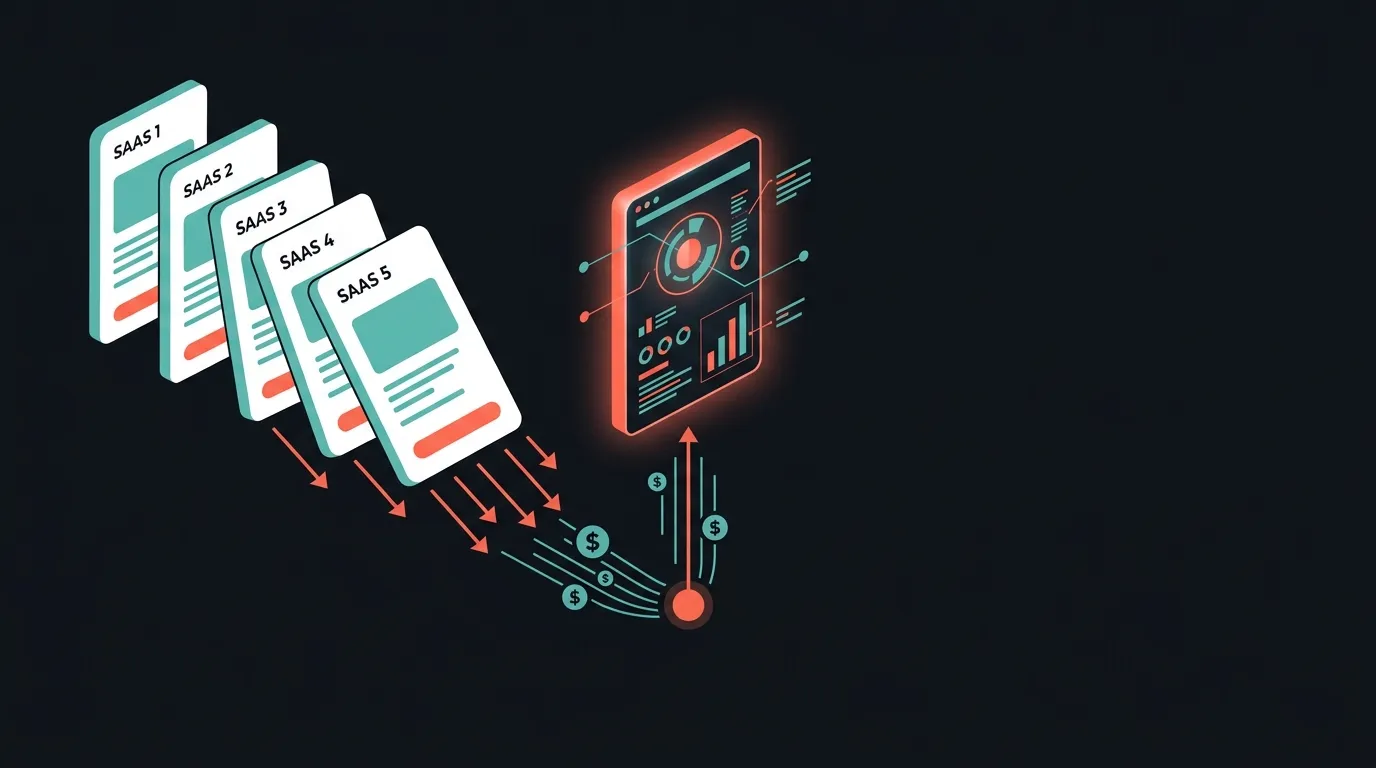
Add up what your business pays monthly for software. CRM, project management, chatbot, booking system, maybe a design tool or two. For a typical UAE SME with 20 to 50 staff, that number lands somewhere between AED 3,000 and AED 15,000 per month. Over three years, that is AED 108,000 to AED 540,000 spent on software you do not own, cannot fully customise, and have no control over when the vendor decides to raise prices or sunset a feature you depend on.
We see this pattern constantly with businesses across Dubai, Abu Dhabi, and the wider GCC. They adopt a SaaS tool because it is the fastest option at the time, then three years later they are locked in, paying per seat, and using maybe 30% of the platform’s features while the other 70% just adds clutter.
Here are five tools we see UAE businesses overpaying for regularly, and what it looks like to replace each one with something you actually own.
The five tools worth questioning
1. CRM (Salesforce, HubSpot)
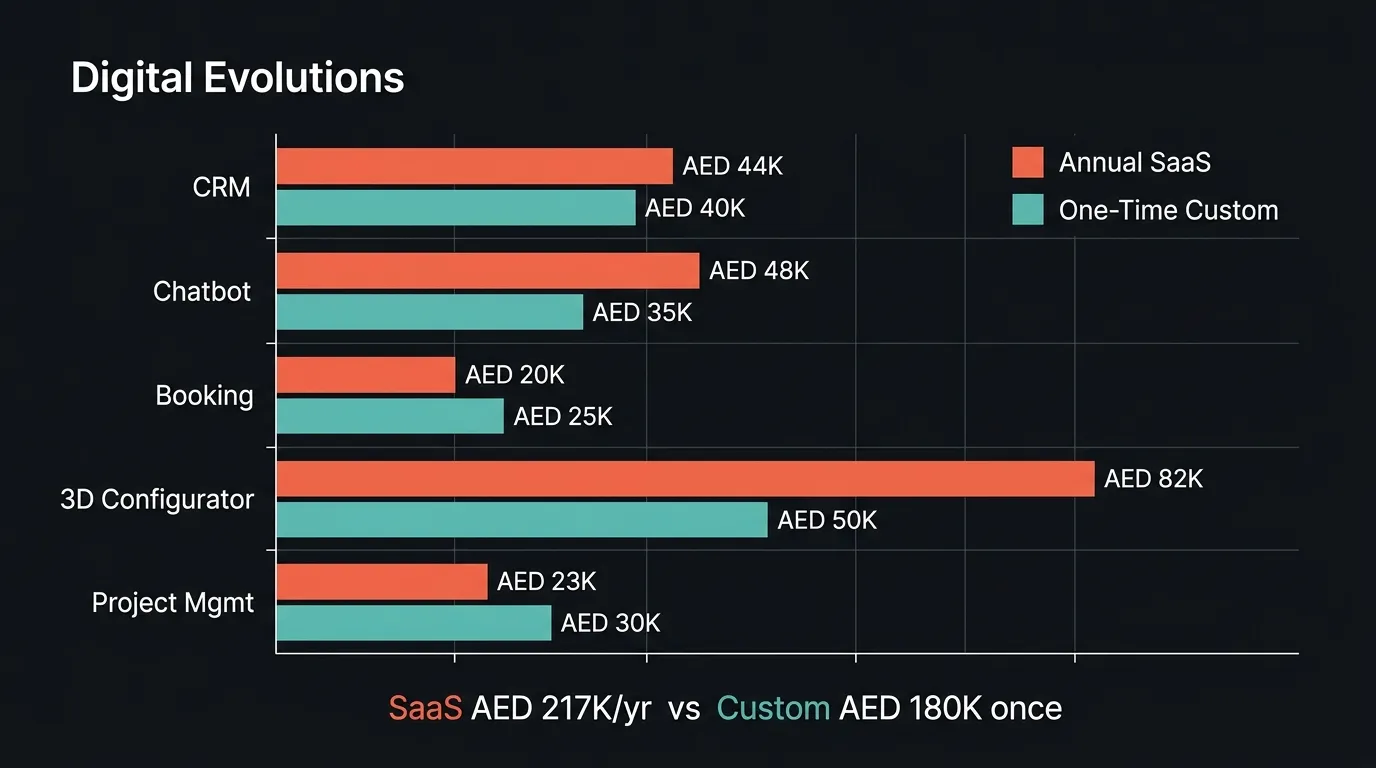
Typical SaaS cost: $50 - $150 per user per month. A team of 10 is AED 22,000 to AED 66,000 per year. That climbs every time you add a salesperson. Most UAE businesses we talk to use about a third of the CRM features they pay for.
Custom alternative: A CRM built around your pipeline, your deal stages, your follow-up cadence, and your reporting needs. No unused modules. No per-seat tax on growth. One-time build, you own it outright, hosted on your infrastructure.
2. Chatbot / Customer Support (Intercom, Tidio, Drift)
Typical SaaS cost: AED 2,000 - AED 7,000 per month. Premium tiers that include AI features or WhatsApp integration push that higher. And you are still limited to canned flows the vendor designed for a global audience, not a GCC one.
Custom alternative: An AI chatbot trained on your actual business data, handling enquiries in English and Arabic, deployed on WhatsApp where your customers already are. The bot learns your products, your policies, your tone.
3. Booking / Scheduling (Calendly, Mindbody, Booksy)
Typical SaaS cost: $30 - $300 per month per location. Multi-location businesses in the UAE hit this ceiling fast. Add payment processing fees on top, and the platform takes a cut of every booking.
Custom alternative: A booking system purpose-built for your specific flow. Dubai Sports Camps replaced a WooCommerce setup with a custom system built around how parents actually book holiday camps. Notery Space launched with custom booking from day one. No per-transaction fees. No platform limitations.
4. 3D Product Configurator (Threekit, iONE360)
Typical SaaS cost: AED 55,000 - AED 110,000 per year. Enterprise 3D configurator platforms charge licensing fees that assume you are a furniture multinational, not a UAE brand that needs a configurator for one product line.
Custom alternative: We built a 3D configurator on open-source model-viewer technology. The client owns it completely. Zero ongoing licensing fees. It renders in-browser, works on mobile, and does exactly what their customers need without paying for an enterprise platform.
5. Project Management / Internal Tools (Monday.com, Asana Premium)
Typical SaaS cost: $10 - $25 per user per month. With 30 users, that is AED 13,000 to AED 33,000 per year. And your team is still forcing their actual workflow into someone else’s template structure.
Custom alternative: A dashboard and task management system built around how your team actually works. Your terminology, your approval chains, your reporting views. Not a generic board with columns you rename and hope for the best.
The math that changes the conversation
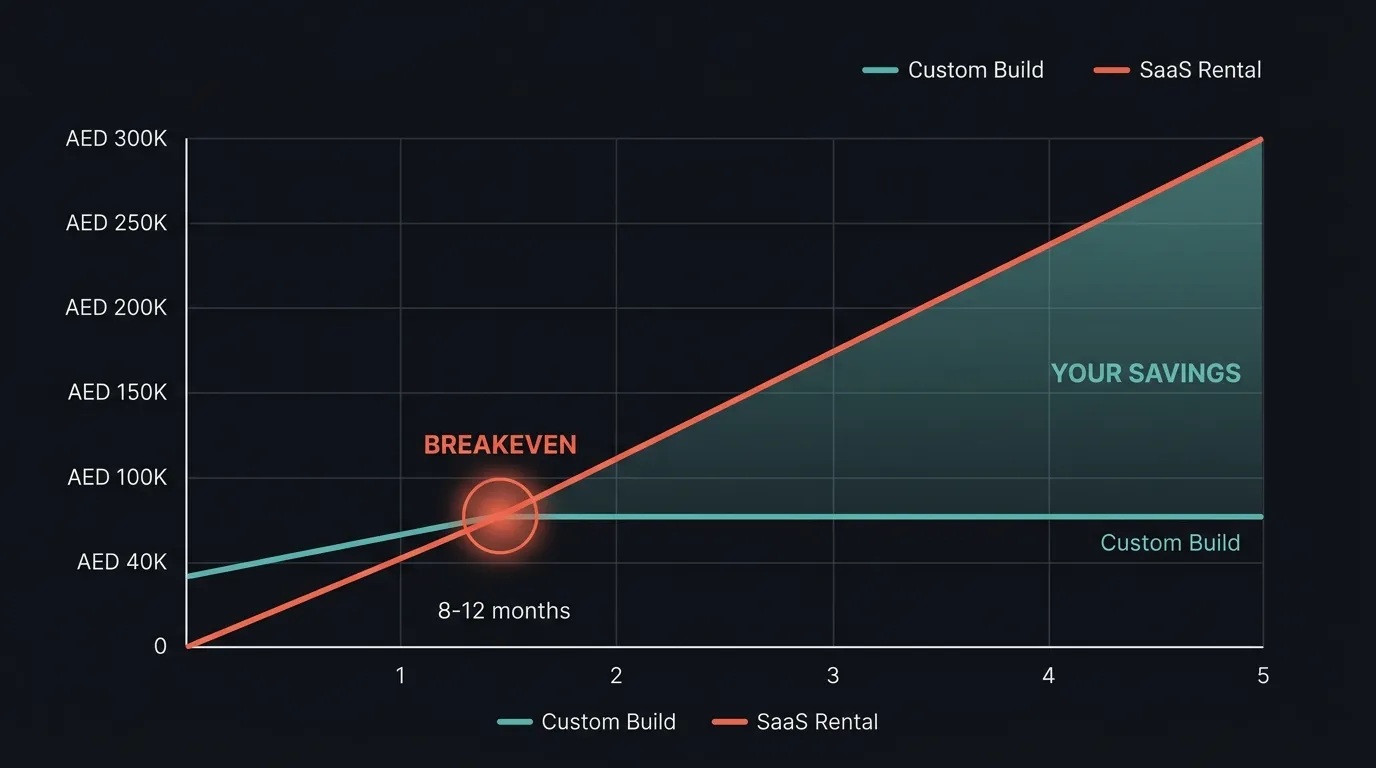
A custom-built tool typically costs AED 20,000 to AED 60,000 as a one-time investment. The SaaS equivalent costs AED 30,000 to AED 60,000 per year, every year, with annual price increases baked in.
That means breakeven in 6 to 12 months. Every year after that is pure savings. And you own the tool completely. No vendor can raise your prices, remove features you rely on, or shut down the product because they got acquired.
Over a five-year window, the difference between renting and owning is often AED 100,000 to AED 250,000 per tool. Multiply that across three or four SaaS products and you are looking at half a million dirhams that stays in your business instead of leaving it.
When NOT to replace SaaS
We would be doing you a disservice if we said everything should be custom-built. It should not. Some software is better left as a subscription.
Email and collaboration (Gmail, Outlook, Google Workspace) — the infrastructure behind these is massive and constantly maintained. Do not try to replicate it.
Accounting (Xero, QuickBooks, Zoho Books) — UAE VAT compliance, bank feeds, and audit trails are handled well by established platforms. The regulatory overhead of maintaining your own is not worth it.
Cloud infrastructure (AWS, Vercel, Cloudflare) — this is the plumbing. You build on it, you do not replace it.
The rule of thumb: replace SaaS when you are paying for features you do not use, when the tool does not fit your workflow, or when per-seat pricing is scaling faster than your revenue. If the tool fits and the pricing is fair, keep it.
How to start
Tell us which tools you are paying for and we will tell you which ones make sense to replace. It is a 30-minute conversation, not a commitment. We will look at what you are spending, what you are actually using, and where a one-time build would save you money inside the first year.
Most businesses we work with in the UAE find at least one or two SaaS tools where the economics clearly favour owning. Sometimes the answer is none of them, and we will tell you that too.
Start a conversation and bring your SaaS invoices. We will do the maths together.