
We didn’t adopt AI. We partnered with it.
There’s a version of AI adoption that looks like this: bolt it onto your existing process, save 10% on boilerplate, call it innovation. That’s not what we did.
Eighteen months ago, we rewired how Digital Evolutions builds software from the ground up. Claude Code became our primary development partner — not a code completion tool, not an assistant we check with occasionally, but the core of how we think, plan, and ship.
The results speak for themselves: four production MVPs in three months, each one shipped to real users, taking real payments, solving real problems. That’s not a productivity improvement. That’s a fundamentally different way of building.
What agentic development actually looks like
Most people hear “AI-assisted coding” and imagine autocomplete on steroids. Agentic development is something else entirely.
Our senior developers don’t write code line by line anymore. They architect solutions, make design decisions, and direct an AI agent that understands the entire codebase. The agent handles implementation — scaffolding components, writing tests, building API routes, refactoring across files. The developer focuses on what actually matters: is this the right solution for the business?
A typical session looks like this:
- Developer: “We need a booking system. Parents select a camp, pick dates, add children, pay online. The operator sees a dashboard with attendance and revenue.”
- Agent: Builds the data model, API routes, frontend components, payment integration, and admin dashboard — asking clarifying questions along the way about business rules and edge cases.
- Developer: Reviews, tests with real scenarios, adjusts the approach based on domain knowledge the agent doesn’t have.
The developer’s job shifts from typing code to making decisions. And decisions are where experience matters most.
Why this matters for our clients
The economics changed overnight. Here’s what that looks like in practice:
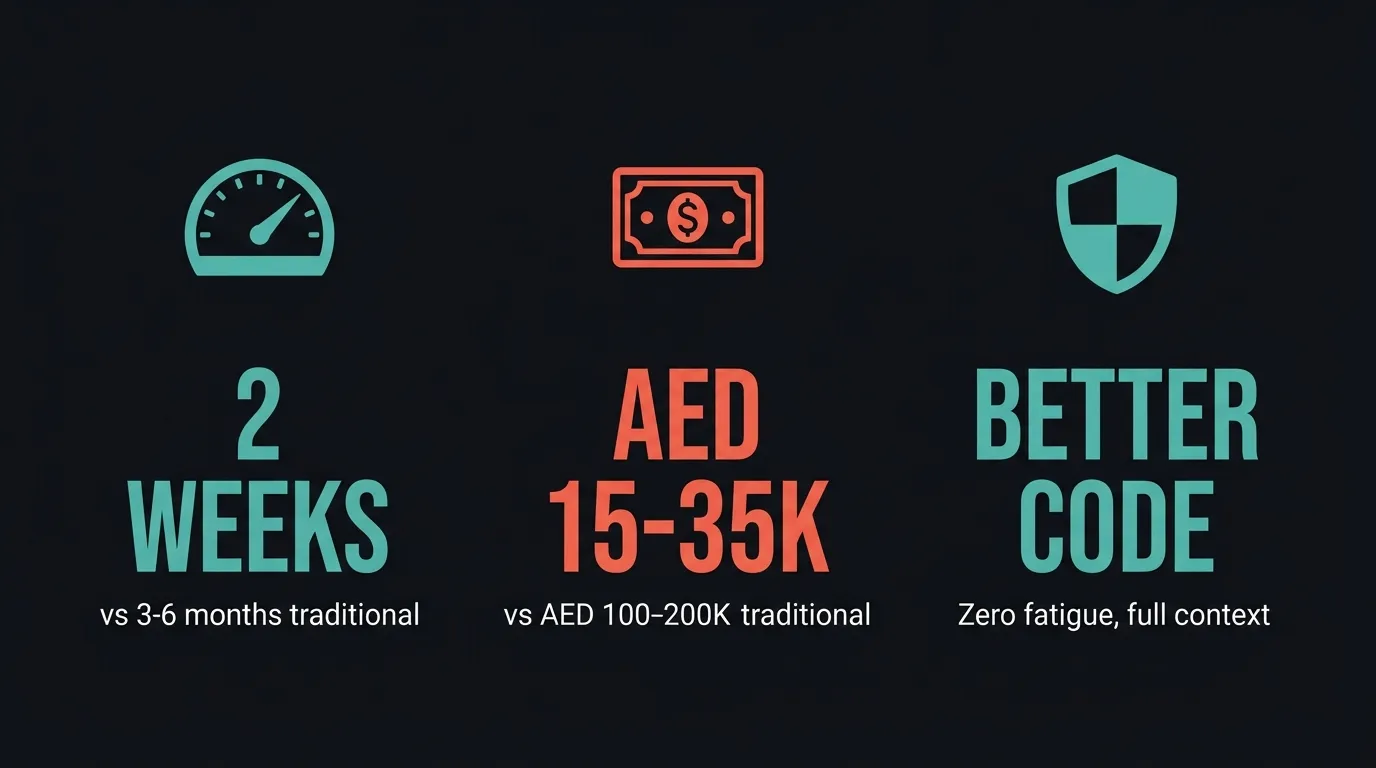
Speed. What took a team of five developers three months now takes one senior developer two weeks. Not because we’re cutting corners — because the overhead of coordination, context-switching, and boilerplate is gone.
Cost. We pass the efficiency to our clients. An MVP that would have cost AED 150,000 at a traditional agency costs AED 15,000-35,000 with us. Same quality. Same production readiness. Different economics.
Quality. This is the counterintuitive part. AI-assisted code is often better than purely human-written code. No fatigue at hour eight of a sprint. No forgetting to handle edge cases. No inconsistent naming conventions across a codebase. The developer focuses on architecture and business logic — the parts where human judgement is irreplaceable.
The tools we use
We’re not vendor-locked to one AI provider. Our stack evolves constantly, but today it looks like:
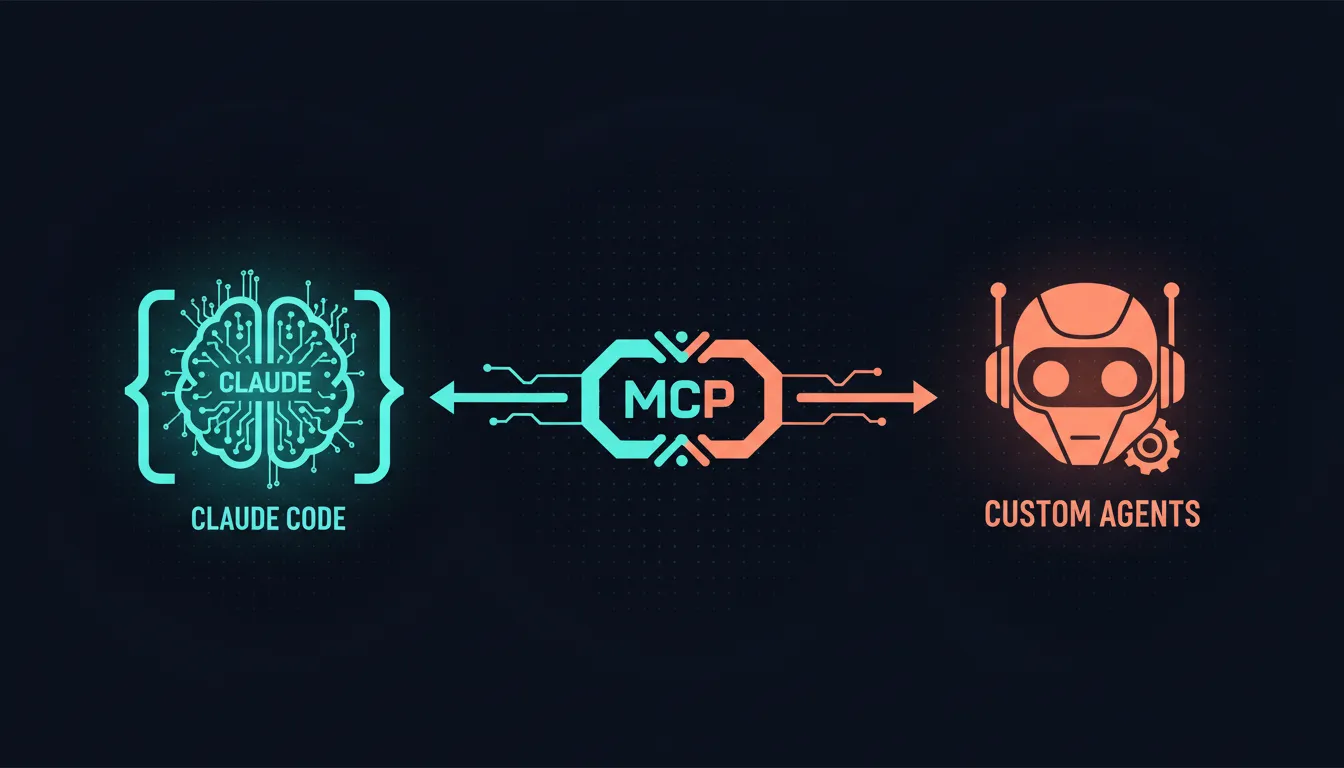
- Claude Code — Our primary development partner. Full codebase context, multi-file editing, architectural reasoning.
- MCP (Model Context Protocol) — Connects our AI tools to client systems. CRM, inventory, documents — the AI can read from and write to the actual business tools.
- Custom AI agents — We build agents for our clients that handle customer support, document processing, and workflow automation. The same agentic approach we use internally, packaged for their business.
This blog exists because of agentic development
In the spirit of full transparency: this website — the one you’re reading right now — was built using the exact process we’re describing. The Astro framework, the component architecture, the responsive design, the blog system, the Cloudflare deployment. All of it was built by a developer working with Claude Code as a partner.
Every blog post you read here. Every page you navigate. Every animation you see. Built in days, not months. That’s not a sales pitch. That’s just how we work now.
What’s next
We’ll be writing here regularly about the practical side of AI-powered development — not the hype, not the theory, but the real lessons from building real software for real businesses in the UAE and the wider GCC.
If you’ve been sitting on an idea because the timeline and budget didn’t make sense, start a conversation. The economics have changed, and we’d love to show you what’s possible now.