The assumption that’s costing you time
Most founders we talk to in the UAE have the same starting assumption: building their idea means three to six months of development and a budget north of AED 100,000. They’re not making that number up. That’s genuinely what traditional agencies charge, and that’s genuinely how long it used to take.
But the economics of software development have changed dramatically in the last two years, and most people haven’t caught up. If you’ve been sitting on an idea because the numbers didn’t make sense, it’s worth reading the next five minutes.
What an MVP actually is
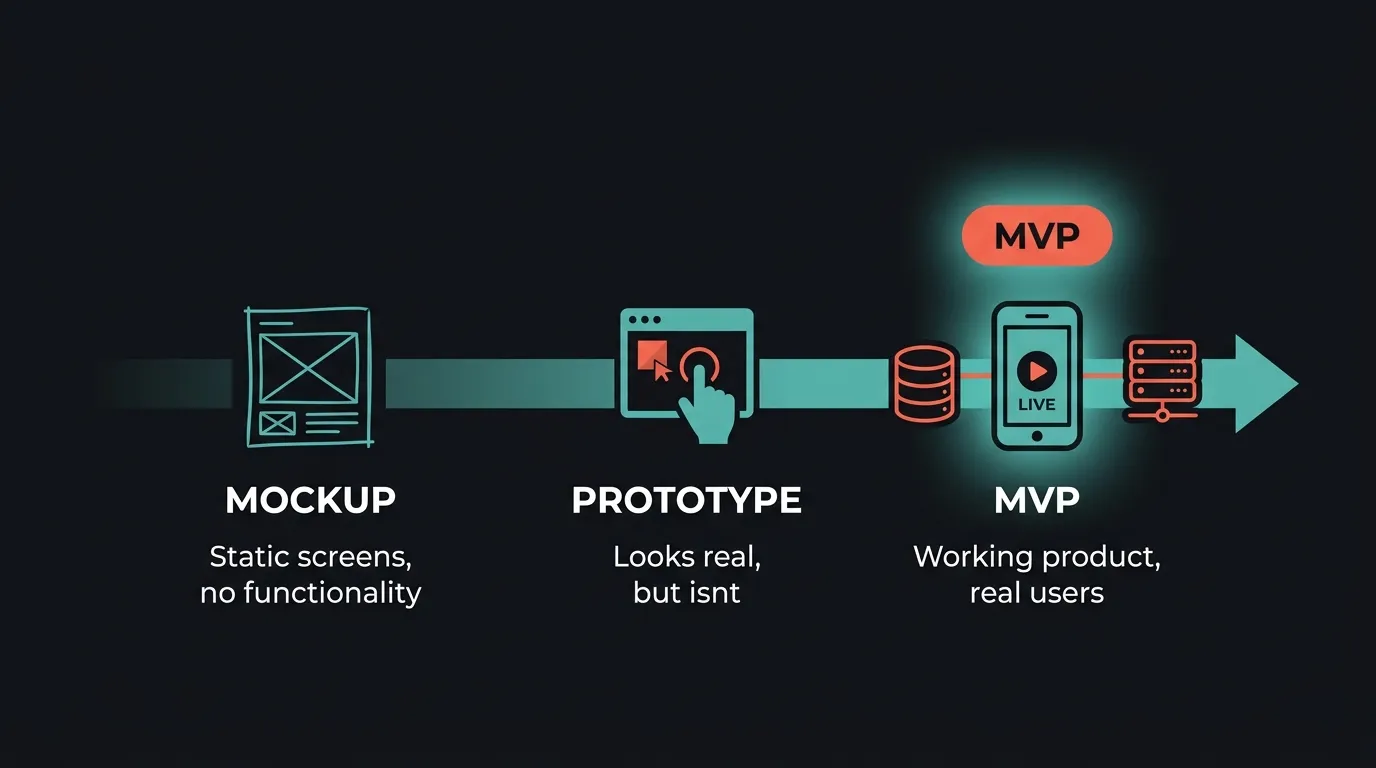
Let’s clear something up first, because this term gets thrown around loosely. An MVP — minimum viable product — is not a mockup. It’s not a set of wireframes. It’s not a clickable prototype in Figma. Those are useful tools, but they’re not a product.
An MVP is a working application. Real users can sign up, log in, and perform the core action your business depends on. It has a database, it runs on a server, it has a URL. People can use it and tell you what they think. The “minimum” part means we build only the features needed to test your idea — not every feature you’ll eventually want. The “viable” part means it actually works.
That distinction matters because a working product gives you something a prototype never can: real feedback from real users. And real feedback is what turns an idea into a business.
How we get from idea to working product
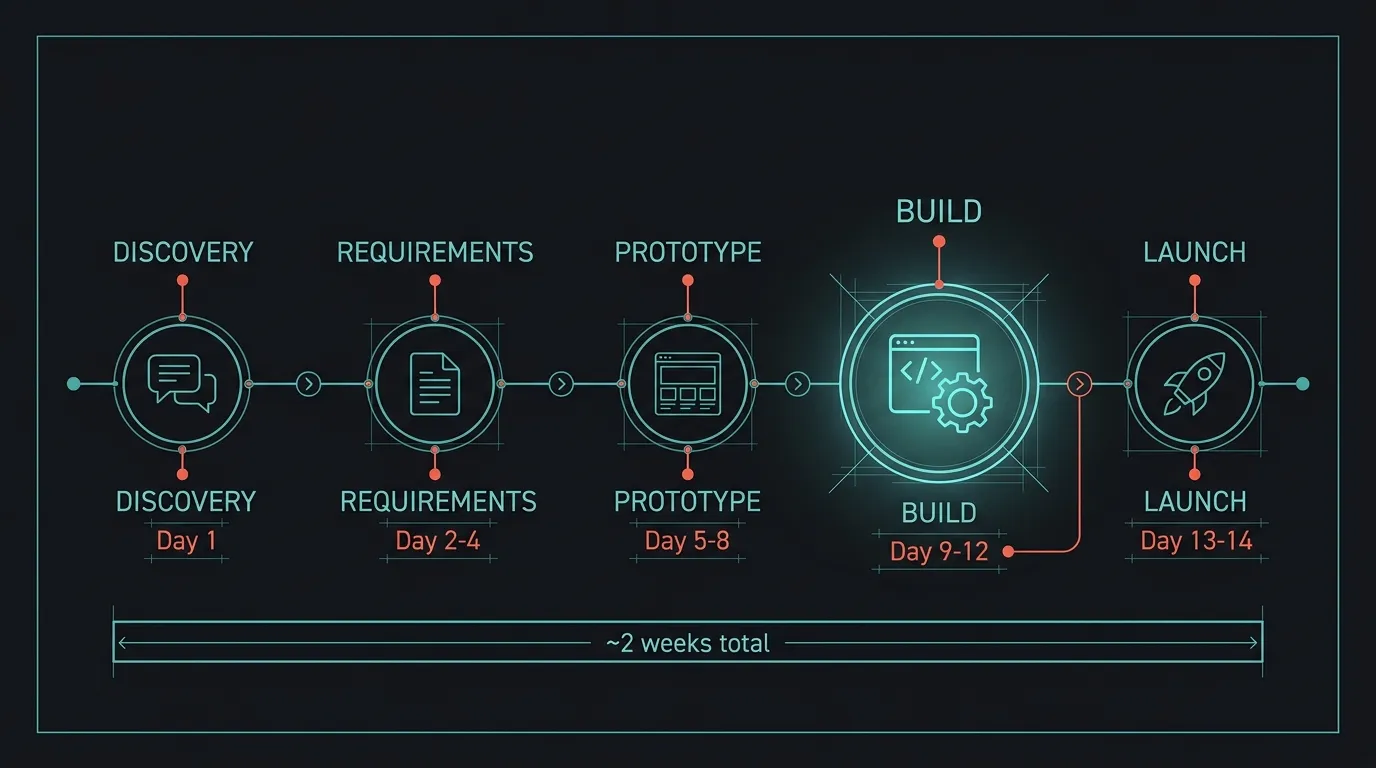
We’ve refined this process across dozens of builds. It’s five stages, and the whole thing typically runs inside two weeks — with the actual build happening in a focused sprint of days, not months.
-
Discovery — One session, under two hours. We sit down (or jump on a call) and understand the problem you’re trying to solve. Not what features you want — what problem you’re solving and for whom. This is the most important two hours of the entire project.
-
Requirements document — We turn that conversation into a clear, jargon-free scope document within two to three days. This locks down exactly what gets built. No surprises, no scope creep, no “that’ll be extra.”
-
Prototype — Before we write a single line of code, you see a clickable design of every screen. You approve it, request changes, or tell us we’ve missed the point entirely. This takes three to five days and saves everyone from building the wrong thing.
-
Build — The sprint. A senior developer working with AI-assisted tools, building the approved design into a live application. This is where the speed comes from, and we’ll explain why in a moment.
-
Launch — Deployed to production, documentation handed over, you’re live. Not a staging environment, not a demo link. A real product your users can access.
We’ve written about this in more detail on our How We Work page if you want the full breakdown.
Why it’s faster now
Two years ago, this timeline would have been unrealistic. The reason it works today comes down to a fundamental shift in how software gets built.
We use Claude Code as a development partner — not as a gimmick or a marketing angle, but as the core of how we work. A senior developer working with AI-assisted tools can produce what used to require a team of four or five people over several months. The AI handles the repetitive scaffolding, the boilerplate, the pattern implementation. The developer focuses on architecture, business logic, and the decisions that actually matter.
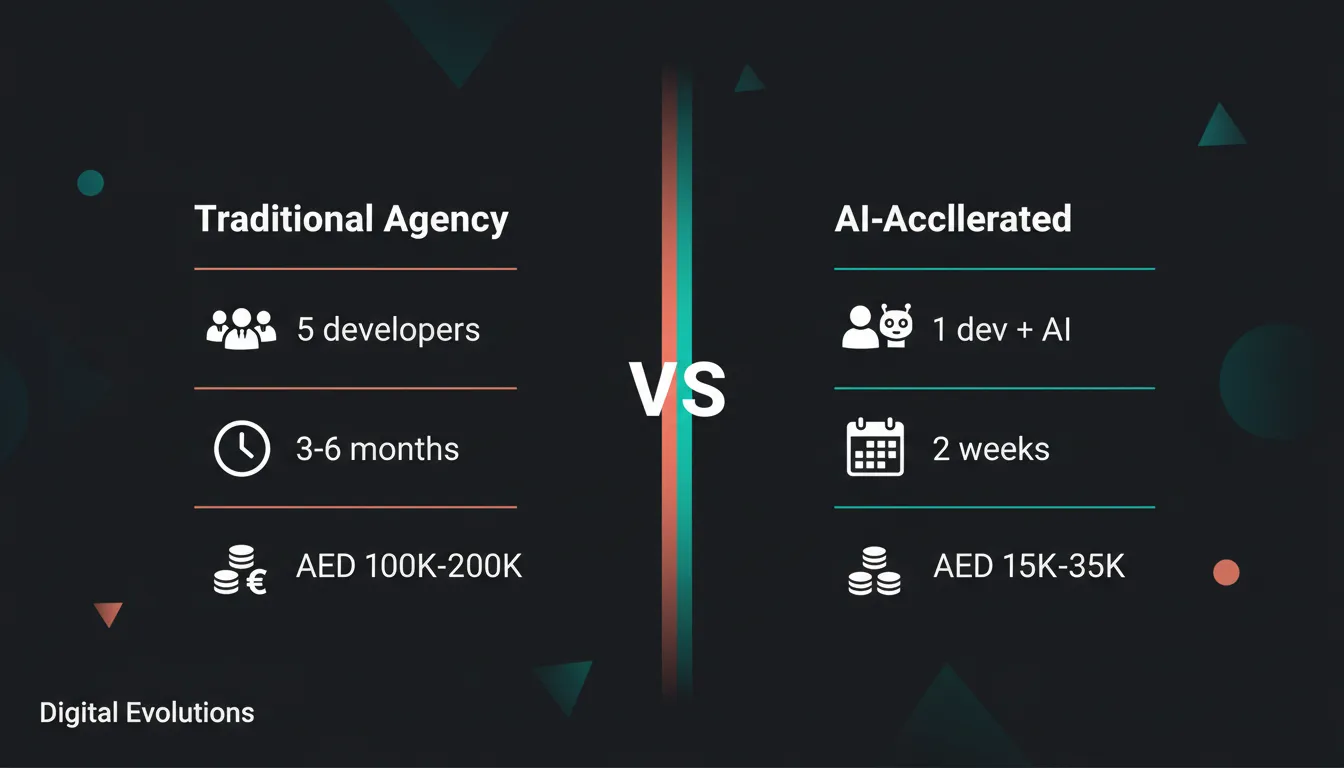
This isn’t about cutting corners. The code quality is the same — often better, because there’s less human fatigue in the process. It’s about removing the overhead that made everything slow: the coordination between multiple developers, the context switching, the meetings about meetings. One experienced developer with the right tools, building with full context of the entire codebase, moves faster than a team of five with a project manager trying to keep everyone aligned.
What it costs
We believe in transparent pricing. Here’s what MVP development actually looks like in 2026:
MVP pricing at Digital Evolutions
| Tier | Price |
|---|---|
| Basic MVP — core feature, auth, simple UI | AED 8,000 – 15,000 |
| Feature-rich MVP — multiple user roles, dashboards, integrations | AED 15,000 – 35,000 |
| Full MVP — payments, complex auth, advanced logic | AED 35,000 – 60,000 |
Compare this to traditional agency pricing: AED 100,000 – 200,000+ with a 3–6 month timeline. Same result, different economics.
The range depends on complexity, not on how long we take. A booking system with one user type is different from a marketplace with buyers, sellers, and an admin panel. We scope every project individually and quote a fixed price before any work begins.
Real examples, not hypotheticals
We’re not speaking theoretically. Here are real projects we’ve delivered:
-
ThinkPool — went from a concept conversation to a live platform with over 1,000 users in weeks. The idea was validated, iterated on, and scaled — all starting from an MVP.
-
Notery Space — a co-working booking system that was live and taking real bookings from the day the business opened its doors. Not after a six-month build cycle. Day one.
-
One client’s MVP performed so well with early users that it converted into a full SaaS product within months — with paying customers already onboard before the “full” version was even finished.
These aren’t outliers. This is how we work.
Who this is for
This approach works well for a specific type of person and a specific stage of business:
-
Founders with a validated idea — you’ve done the thinking, you’ve talked to potential users, and now you need the product to exist so you can prove the business model.
-
Corporate innovation teams — you need a proof of concept to show the board, test internally, or pilot with a select group before committing a full enterprise budget.
-
Businesses testing a new offering — you have an existing operation and want to test a digital product alongside it without betting the whole business on a guess.
This is not for people who want a fully polished enterprise product on day one. An MVP is a starting point — a working one — that you refine based on what your users actually do. If you need SAP-level complexity from launch, that’s a different conversation and a different timeline.